fredag 25 november 2022

Wadi Rum Nature Tours


Take nothing but pictures,  leave nothing but footprints.

Wadi Rum consists of two different desert types, Red Desert and White Wild Desert. 

Try to plan your time in Wadi Rum so that you can see both.

The picture above is from the red desert. The picture bellow is from the white wild desert.


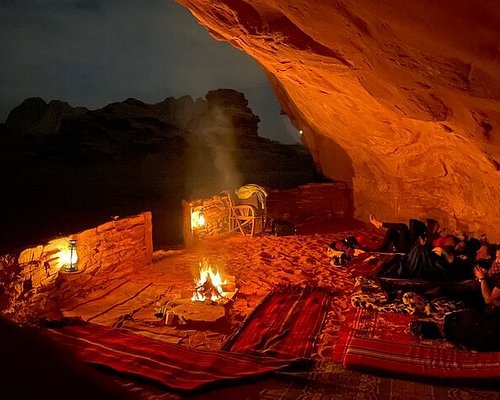
If you want to get to know this place better, stay overnight in a Bedouin tent. Sunsets have an extraordinary charm in the red-pink landscape, and you will be watch by a million stars at night.

There is not only the beauty of nature but also many cultural monuments, such as the inscriptions Anfashieh or the remains from the Nabataean period like a temple in begin of the village and many other ancient ones drawings on the rock. You can even find the remains of old cemeteries and much more.


Wadi Rum is not a lifeless desert. As part of this reservation, there are 2,000 people living here - Bedouins from the Zalabiah tribe, who have long considered the beautiful Moon Valley to be their home. 

Some Bedouins already live a settled way of life, especially in the village of the same name. But some is still living in the desert, taking care of their animals, have a farm there, move from place to place when the grass is finish. 


What you can do for activity

* Jeep tours - full day or half day
 
   in the red desert you can do the full or half day or only 1-2 hours
 
   but in the white desert it is recommend to do the full day tour


* Jeep tours combined with 1 hour camel ride  - this tour is done only in the red desert


* Camel ride the full or half day or only a couple of hours in the red desert


* Hiking and climbing
 
mostly in the white desert and you have two opportunity of climbing up
 
   * on Um Adaami, Jordan's highest mountain at 1832m above sea level
 
  
    * or on Jebel Burdah or Jebel Hash


*  Hot air balloon ride over Wadi Rum


Keep the desert clean and take care of.

To protect its unique desert landscape, Wadi Rum was declared a protected area in 1998 and an intensive conservation program is now underway.

 
A group of Bedouin experts started working towards a common goal - "Eco tours and camping"
  • Presenting Wadi Rum's Bedouin life in an authentic way
  • Facilitate meetings between visitors and locals
  • Provide positive experiences for both
  • Promote cultural exchange and responsible tourism

Take time out and enjoy unique moments with your family or friends in our beautiful desert. Bedouin offer you beauty and education in abundance for you who are interested in the environment, outdoor activities and fun. They focus on unadulterated, untouched natural environments.

You will hike in the most intact nature in our desert, far from the main trail. You can witness the beauty of the desert while participating in hiking, climbing, bird and wildlife viewing and more!

You can make an observation of flora and fauna, astronomical phenomena but also gastronomic experiences to cook in the desert.

You stay in the traditional Bedouin tent, but you can even sleep under the stars or in any cave and follow as much as possible the Bedouin's original lifestyle.

Bedouin have traditionally lived in tents known as buryuut hajar (house of hair). They have traditionally been made black goat-hair and are usually square or rectangular. The dark fibers attract the sun's heat to keep the tent cool during the day and warm during the night. When it rains, the fibers swell to block out water and create a waterproof seal.''
 
                                   Rather than a tour of the desert, they give you a look into life in the desert
 
 
They also used to live in caves in the past although tourists who choose to stay over in the have more comfort than Bedouins had long ago.


A couple of example for traditional Bedouin camp camps. The smaller the greater experience of the life in the desert. You get better contact with staff and owners, they show you many interesting places, they tell you about their habits and customs, different stories, etc. It's usually not that crowded there when there are only up to 10 tents.


For to save the desert this group built their camps with only shared bathroom which are more gentle for environment than to have private bathroom in each tent. 
 
There are many reasons for that, but the most important points for to keep virgin desert are as below:

* building a bathroom in the sand is not so simple, it needs cement etc. which however spoil the sand
* the desert changes if daily amounts of water are mixed with soap running out into the sand
* even if the water from the shower is collected and recycled into flush in toilets, it runs the sand
* but, in the desert there is no channeling

Conclusion: the more private bathrooms there are, the faster the desert is destroyed


lördag 26 mars 2022

March 2022 - around in Wadi Rum incl. meeting with Bedouin Eco tourism

This trip began be funny, I flew from Milan to Aqaba by EasyJet but we were only 5 persons on the flight, it felts so strange. And I was gladly surprised that the flight wasn't cancelled because it would be boring. But we were lucky and could fly to Jordan, to Aqaba.


In Aqaba it was warm so it was nice compared to Milan where it was still quite cold. I rented the car at the airport and drove then to Aqaba, to my favorite hotel Al Quidra hotel, good location, many restaurants around so I not needed to go far. Anyway I would stay there only over night and next day I drove directly to Wadi Rum.

I recommend this hotel, nice rooms are there and staff is very helpful. 


Due continued risk for to be infected of corona they   had not opened breakfast room but I got breakfast served directly to my room, so it was perfect and comfortable.


   But dinner I got to eat outside, found near one nice restaurant and I got a very good dinner. 


As said, I stayed only one night and next morning I drove directly to my loved desert Wadi Rum where I stayed the whole time, 2 weeks. But of course each day I did some trip by my car, sometimes with my friend we were going to the desert. But this year it was very cold March so it was pity. Sometimes it blew cold wind so it was not so nice to stay outside. So cold as this time I never experienced there before. But it was cold everywhere, not only in Jordan, but in Europe in any case.

I rented the car for the whole time so I could drive around quite much and visited all places I wanted to see around Wadi Rum protected area and especially wished to see those terrible bubble camps and luxury camps also because I do not understand why tourists began suddenly to prefer such camps instead for a more genuine Bedouin camps which are much more nicer than those horrible resorts.

Do not understand what it can be so fantastic to look at wall in front of the entrance into the "tent"as I saw in one such resort or if one get a "tent" in second line, they see not the desert, but then one bubble in front of them. 

Thankfully most are outside the protected area but around Ad Disa, a larger village, to left off the road to the protected area.
But unfortunately, there started to be here and there in the protected area those too and it doesn't fit there at all, it looks terrible.
However, I hope that there will not be too many such things built within the protected area so that it remains beautiful and not destroyed much.

I got to talk with some locals about those "things" and they told to me that "Most "luxury", "glamping", "bubbel", "luxotel" or "hotels" in our area are owned by Amman/international businessmen who couldn't care less about the fate of our Homeland and our people. Thus, they don't care about where they dump their trash and waste water and energy but only about the profits from rich people. Some alleged "Bedouin/family camp" owned business are just lying and do the same, so make sure to do your research and refrain from these kinds of offers. There are real Bedouin run stays like ours who want to keep living here!"

One other had a this comment: "Wadi Rum's primary appeal is it's natural beauty and cultural identify as recognized by UNESCO. It is therefore impractical that people travel long distances to the desert and stay in accommodation with bright lights connected to the asphalt road network with coaches pulling up and various other amenities that completely overshadow the desert environment. Similar offerings exist along the Dead Sea with superior facilities and easier accessed if visitors merely want comfort without experiencing the identity of the destination. As mentioned so many alternatives within the desert away from major infrastructure are overlooked when they offer a far greater opportunity to experience both the natural and cultural beauty of the destination. Instead many visitors are drawn to venues where local cultural elements have been completely forgotten and the convenience of coach access and high energy consumption units such as AC are the primary considerations for construction."

So I am happy there are more people thinking the same as me and hope that the authorities will make sure to keep this beautiful desert as pristine as possible.

Below I will show a couple of such resort and "bubble tents" so you can have an idea how it can looks at.


Or how "fantastic" it must be to stay at such luxury hotel with a "wonderful view over electricity poles.


But of course, 

I drove not around such things but even around to the landscape along roads, looking at for example abandoned rails of Hejaz Railway in direction towards Mudawara into Saudi etc.


By the way, in Mudawara is Al-Mudawara Castle, or Jagiman Castle, a desert castle used in the Mamluk and Ottoman eras as a stop for caravans of Hajj, and the last pilgrim stations to Al-Shami before the start of the sandy plain in northern Hijaz.
Arab tribes, and since previous ages, have been concerned with protecting the convoys of the Levant and the Egyptian pilgrims that crossed their regions.

Have also gone and looked at the starting line where there is a camel race every year, but there was almost a sandstorm when I was there so there weren't that many good pictures to take.


Another day I went with my friend to find Qasr Tuba which I wish to see so much for many years already, but it is a bit far from Wadi Rum and somehow never been possible to go and visit it.

But this time because I had the car for so many days it was opportunity to go and hope to find it. It was far of course and we took the road no. 5 from Ma'an. That road I like very much, it is calm, not busy at all and there are many camels along the road walking there. 

But it was not so easy to find Qasr, we were talked that there we will see a sign showing to right but we never found the sign. We asked locals, even a policeman who was driving and all of them said that we are now on right location and should park the car there and go by foots in the direction they showed us to go. So we parked and gone, it was not se easy to walk, stones smaller and bigger, we were going down and up, looking, searching, but without success. We checked even google map but it was not so good connection and it had misled us a bit.
So at the end we gave up, gone back to the car and drove back home. Saying that next time we will have a 4x4 and drive there again and then we have to find it, next time. Inshallah.

On the way back to the car I was lucky and found one very nice stone, not know that it could be, if it is something ancient or so, but really nice and interesting, so I took a picture, of course. Maybe next time I am there I will find more of such similar stones and then take one with me for to investigate, what it can be for.


I like to drive through the desert and it is really exciting to drive alone, now I have been there so many times so some directions and piste and similar I know, so one day I got to borrow my friends car, 4x4 and drove alone. But anyway I took it carefully, wanted not to drive lost, even if my friend said he would find me plus explained how I would do if I go lost. 

But, unfortunately, or rather luckily I gone not lost and found back home without problem. Although it would be a bit exciting to go a little lost, not much, but a little bit and see how I would do, LOL.


Back in the village meeting cheep and goats


Take nothing but pictures, leave nothing but footprints

At the end I want to mentioned that Bedouin began start with ECO system tours and offer all visitors tours through the clean desert, showing how to take care of the desert. To discover Wadi Rum and the life there as it was before mass tourism and will get the Bedouin life experience in this one of most spectacular desert

For example to take firewood with you and do not collect it in the desert where you only pick dry wood that is already on the ground, but never tear twigs from bushes or trees. Or how to use natural plants as a soap etc. To safe water also as much as possible.

We all should give our support to this project as much as possible so that a traditional desert lifestyle will remain forever.